
By Evan Coffey & Kate Templeton
When financial markets misbehave, policymakers tend to take action. That reflex has played out twice over the last month, once in currencies and once in fixed income. Both times the response looked decisive. Both times, too, markets rallied briefly on the news before giving much of it back within days, or in the bond market’s case, within a single session. The interventions themselves were different in mechanism and scale, but they shared the same shape. Officials moved forcefully on what they could control, while what was actually driving the pressure went untouched.
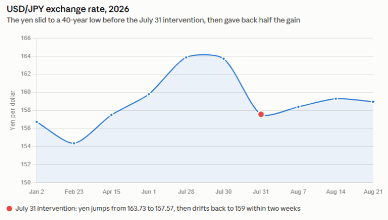
In late July, the yen fell to a 40-year low against the greenback, sliding to 163.73 per dollar. The decline was driven by a wide interest rate gap between Japan and the U.S., with Japan’s accommodative monetary policy pushing up import costs and fueling inflation. The prolonged weakness of the yen threatened Japan’s import-dependent economy and risked destabilizing U.S. Treasury markets, since Japan is the largest foreign holder of U.S. government debt. Japan responded by spending an estimated $87 billion buying yen over two days in late July, its largest two-day intervention outside of 2011. The U.S. joined in for the first time since 1998, notably funding its share by selling euros rather than dollars, a detail that left many analysts questioning the move. The yen jumped from 163.73 to 157.57 per dollar on the news. Within two weeks it had already slid back to 159, giving back roughly half the gain.
The bond market told a similar story last week. The 30-year Treasury yield touched a multi-degree high above 5.33%, the product of what officials called a buyers strike at the long end of the curve since late June. The U.S. Treasury responded by at least doubling the size of its long end buyback operations, from a $2 billion cap to at least $4 billion per operation, targeting nominal coupon securities with maturities of 10 years or longer. The reaction was immediate. Stock futures popped and all three major indices finished the day about three tenths higher, snapping a three-day losing streak. Major crypto currencies jumped over 7% in the same session and on the fixed income side the 10-year yield fell 6 basis points to 4.647%, and the 30-year fell nearly 9 basis points to 5.196%. The relief however was short lived. By the next session, bond yields had already reversed higher, and the Dow dropped more than 700 points, as traders concluded the buyback was, in Bloomberg’s framing, a short-term fix rather than a structural one.
The backdrop the buyback is being layered onto is not improving. The federal deficit hit $432.3 billion in July, the highest monthly total since March 2021, pushing the year-to-date shortfall to $1.8 trillion. Interest costs on the roughly $40 trillion national debt now run around $1.2 trillion for the year alone, a bill that grows regardless of what happens at any single buyback operation.
That debt did not disappear because of a buyback. For a day, though, markets reacted as if something meaningful had been resolved. This market reaction is action bias at work. Action bias is the inclination to do something rather than nothing, even when inaction would lead to a better outcome. Appearing passive feels worse than being wrong. The yen intervention and the Treasury buyback are both cases where the action alone was priced immediately. The primary issues, the rate gap and federal deficit, did not improve.
Both moves treated the symptom, not the disease. The yen intervention bought currency, holding the price up. It did not address the rate differential behind the sell-off. The intervention was rewarded immediately and lasted for almost two weeks before the gain was cut in half. The Treasury buyback decreased the expected bond supply, pushing the price back up, but only for a day. It did not touch the deficit or inflation outlook driving yields up. Because the effects of the yen intervention lasted longer, it looked more successful than the buyback operation, but neither addressed the real problem. The only difference was how long it took investors to realize nothing had changed.
The reason this pattern persists is that the action itself is fast and measurable, whereas the underlying problem is slow and structural. A buyers’ strike and a wide interest rate gap are not issues that can be resolved in a day. The asymmetry of the bias is what causes people to fall into it, repeatedly. Policymakers turn to these tools since they are the only levers they can pull fast enough, not because they are necessarily the right ones to solve the underlying problem.
Action bias was presented at both the institutional and investor level. Governments felt the pressure first, wanting to take action when currency weakened or yields increased so they didn’t look weak. At the market level, investors bought in anyway. None of this makes governments or investors wrong. It just means what reacts first is not always what needs fixing. Either way, nobody wants to be caught sitting around if it works out. History offers us a warning here. In March of 2008, the Federal Reserve bailed out Bear Stearns and markets were immediately calmed. This was a fast, visible action that appeared to draw a line in the sand of where policymakers stood surrounding the housing crisis. For a few months, this line held. Then in September of that year, Lehman Brothers failed, and financial markets learned the difference between a problem that had been solved and one that had been merely delayed. Eighteen years later, the instinct to reach for the forceful, visible fix hasn’t changed. Whether the underlying pressure gets resolved this time around, or simply resurfaces once the relief fades, is the question these actions leave open.
Kate Templeton | Associate, Asset Management
Kate is an Associate on GVA’s Asset Management Team, where she specializes in operations, advisor communication, and strategic account analysis. Kate’s strong analytical thinking and close attention to detail drive her success in streamlining workflows and generating data-driven insights that enhance reporting quality and operational performance.
In 2024, Kate graduated summa cum laude from Ursinus College with a BA in Applied Economics and minors in Management Studies and Psychology. During her time at Ursinus, Kate was a member of the Ursinus College Investment Management Company and the Omicron Delta Epsilon and Psi Chi honor societies. She also served as vice president and social media coordinator for her sorority, Phi Alpha Psi.
Outside of work, Kate enjoys going to the beach, doing pilates, spending time with friends and family, and keeping up with reality TV.
Evan Coffey | Investment Analyst, Asset Management
Evan is an Investment Analyst on GVA’s Asset Management Team. He specializes in investment research and has a passion for finance and economics. Evan uses his strong work ethic and financial literacy to help manage GVA’s multi-asset portfolios, mitigate risk, and help coordinate wholesaler relationships. In the Spring of 2024, Evan graduated as valedictorian from Ursinus College with a BA in Finance and a minor in Management Studies. Evan took part in Finance Scholars and was a CEO of the Ursinus College Investment Management Company. Evan was also inducted into Phi Beta Kappa and Omicron Delta Epsilon during his time at Ursinus. Outside of his coursework, Evan was captain of the men’s golf team and worked on a year-long honors project focusing on the stock-bond correlation and how macroeconomic variables affect the relationship between the two asset classes.
Prior to joining GVA full-time, Evan interned with GVA’s Asset Management team! During his time as an intern he focused on equity research, and shadowing wholesaler and advisor meetings. Under the guidance of the GVAAM team, Evan gained quality professional experience in the finance and asset management industry. Outside of Finance and Economics, Evan enjoys golfing, watching Formula 1 racing, going to Sixers games, and traveling with close friends and family.
Disclosure: I/we have no stock, option, or similar derivative position in any of the companies mentioned, and no plans to initiate any such positions within the next 72 hours. I wrote this article myself, and it expresses my own opinions. I am not receiving compensation for it. I have no business relationship with any company whose stock is mentioned in this article.
Investment advice offered through Great Valley Advisor Group (GVA), a Registered Investment Advisor. I am solely an investment advisor representative of Great Valley Advisor Group, and not affiliated with LPL Financial. Any opinions or views expressed by me are not those of LPL Financial. This is not intended to be used as tax or legal advice. All performance referenced is historical and is no guarantee of future results. All indices are unmanaged and may not be invested into directly. Please consult a tax or legal professional for specific information and advice. LPL Compliance Tracking #1166268
The economic forecasts set forth in this material may not develop as predicted and there can be no guarantee that strategies promoted will be successful. All investing involves risk including loss of principal. No strategy assures success or protects against loss.